
What do you think about the current state of decentralized finance (DeFi)? If you’ve been keeping an eye on the crypto markets lately, you might have noticed quite a few changes that have left many wondering what’s happening. Let’s discuss how recent turmoil in the crypto market has affected borrowing demand in the DeFi space and explore the implications this has for both investors and lenders.
DeFi Borrowing Demand: An Overview
Decentralized finance has been one of the hottest topics in the financial world. For many, it represents a new frontier where traditional financial services are replicated using blockchain technology. However, with every boom comes a bust, and the recent market chaos has had profound impacts on the DeFi borrowing landscape.
When looking at borrowing demand, you might find it surprising to learn that it has plunged sharply recently. This drastic drop is a reflection of many crypto investors unwinding risky positions in response to market volatility.
What Does Deleveraging Mean?
You might be wondering what “deleveraging” actually entails. In simple terms, deleveraging occurs when investors reduce their exposure to debt. This can manifest in various ways, such as repaying loans or selling off assets to lower overall debt levels. In a high-risk environment, many traders feel compelled to limit their leverage in order to protect their investments.
As you consider the factors at play, it becomes apparent that a significant number of crypto market participants are seeking to reduce risk, creating a ripple effect throughout the DeFi ecosystem.
The Decline of Stablecoin Yields
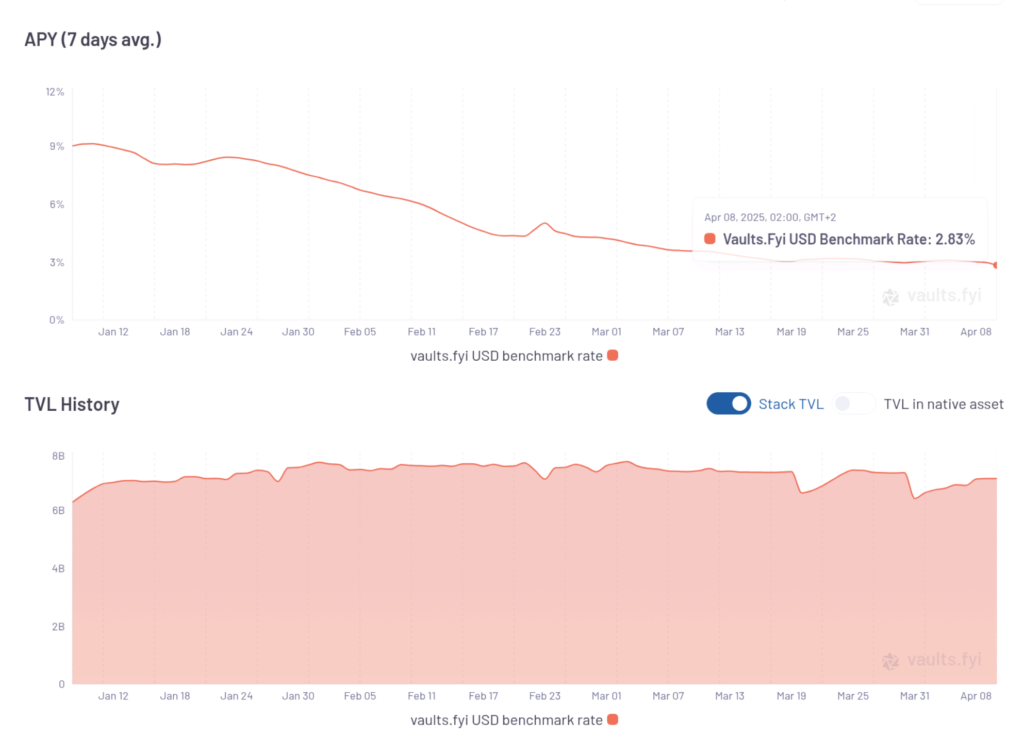
One of the more troubling signs for lenders in the DeFi space is the drop in stablecoin yields. On a recent Tuesday, the average yield on U.S. dollar stablecoins fell to just 2.8%. This is particularly noteworthy as it represents the lowest yield observed in the past year. At the same time, traditional U.S. dollar money market rates are sitting at around 4.3%.
The disparity between DeFi yields and traditional market returns is significant, highlighting the challenges that decentralized platforms currently face. Investors who have been accustomed to high returns may find this sudden drop disconcerting.
Why Are Yields Dropping?
Ryan Rodenbaugh, the CEO of Wallfacer Labs, shed some light on this phenomenon. He pointed out that the current market sentiment is decidedly “risk-off.” In simple terms, this means that investors are stepping back from riskier assets due to recent price volatility. As they repay loans to mitigate their risk exposure, the overall demand for borrowing decreases.
Interestingly, while borrowing demand is down, deposits for lending on DeFi protocols have remained stable. This means that increasing numbers of risk-averse lenders are competing for fewer borrowers, putting downward pressure on yields.
The Impact of Recent Market Carnage
Recent weekend turmoil in the crypto markets only exacerbated the challenges faced by DeFi lending protocols. The declines in major assets like Bitcoin and Ethereum led to significant liquidations across the board.
What Happened?
During a particularly tumultuous Sunday and Monday, Bitcoin prices fell by around 10% to 15% and dipped below the $75,000 mark. Ethereum fared similarly, with values dropping below $1,500.
This volatility resulted in forced liquidations, a scenario where lenders reclaim collateral from borrowers who cannot meet their requirements. For example, Aave, one of the largest lending protocols, reported over $110 million in forced liquidations during this critical period.
Key Liquidations
Consider Sky, formerly known as MakerDAO, which is known for its USDS stablecoin. During this market turmoil, they liquidated a massive $74 million loan collateralized by over 67,000 ETH. This instance illustrates just how dramatic the cascades of liquidations can be in a risk-off environment.
To give you an understanding of what this looks like, let’s break down some of the statistics:
| Protocol | Liquidation Amount | Collateral Type | Value at Time |
|---|---|---|---|
| Aave | $110 million | Various assets | N/A |
| Sky | $74 million | 67,570 ETH | $106 million |
The Numbers: What Borrowers and Depositors Should Know
As someone interested in the DeFi space, it’s crucial to grasp the implications of these trends on both borrowers and lenders. The recent surge in liquidations dramatically impacted the total value of borrowed assets across DeFi protocols.
Aave’s Declining Borrowing Stats
On Aave, the total value of borrowed assets has fallen to around $10 billion. Just a few months ago, in mid-December, this number stood over $15 billion. Such a significant decline highlights the broader trend of deleveraging in the marketplace.
Similarly, Morpho, another important lending protocol, experienced a drop from $2.4 billion to $1.7 billion. You can see how these shifts are creating a challenging environment for both borrowers and lenders.
| Protocol | Total Value Borrowed (Mid-December) | Current Value Borrowed |
|---|---|---|
| Aave | $15 billion | $10 billion |
| Morpho | $2.4 billion | $1.7 billion |

What Does This Mean for Investors?
As an investor, the implications of these trends can influence your strategy moving forward. With lower yields and decreased borrowing activity, it’s vital to consider how to adapt your approach.
Creative Strategies for Lenders
If you are actively lending in the DeFi space, the current environment calls for rethinking your strategy. With yields declining, you might need to look for platforms that provide better return rates or assess the risk levels associated with various assets.
Remember that while the DeFi sector offers the allure of higher yields, it also comes with significant risks. Evaluating the health of the DeFi protocols you’re using is more crucial than ever in light of recent market behavior.
Adjusting Borrowing Strategies
For those of you sampling borrowing capabilities, now may be the time to tread cautiously. Increased liquidations might suggest a more conservative approach is warranted. You can focus on less volatile assets or explore stable strategies that allow for earning interest without taking on too much risk.
Reflecting on the Future of DeFi
The current landscape is troubling, but it is essential to keep things in perspective. Every market has cyclical trends, and it’s not uncommon to experience considerable downturns.
Is DeFi Resilient?
Is DeFi a passing trend, or is it here to stay? That’s a question many investors are pondering. Whether you’re a borrower or a lender, the resilience of DeFi hinges on innovative adaptations and robust risk management.
Investors have shown an appetite for decentralized solutions, and while recent market conditions are challenging, the fundamental principles driving DeFi remain strong. As crypto technology continues to evolve, new strategies and developments may emerge, leading to more robust platforms.

Conclusion: What Lies Ahead?
As we wrap up, it’s clear that the DeFi landscape is experiencing significant flux due to recent market upheavals. A decrease in borrowing demand, declining yields, and an increase in liquidations have created challenges that require strategic adaptation.
If you’re involved in DeFi, whether as a lender or a borrower, it’s essential to stay informed and flexible. The market will undoubtedly experience further changes, and being proactive can make a difference in how you navigate this ever-evolving space.
So as you move forward, keep a close eye on the developments within the DeFi ecosystem and be prepared to adjust your approach based on the trends that emerge. Your ability to adapt could be pivotal in seizing new opportunities in an increasingly complex market.